Earth Hero Interview: Bright Saver
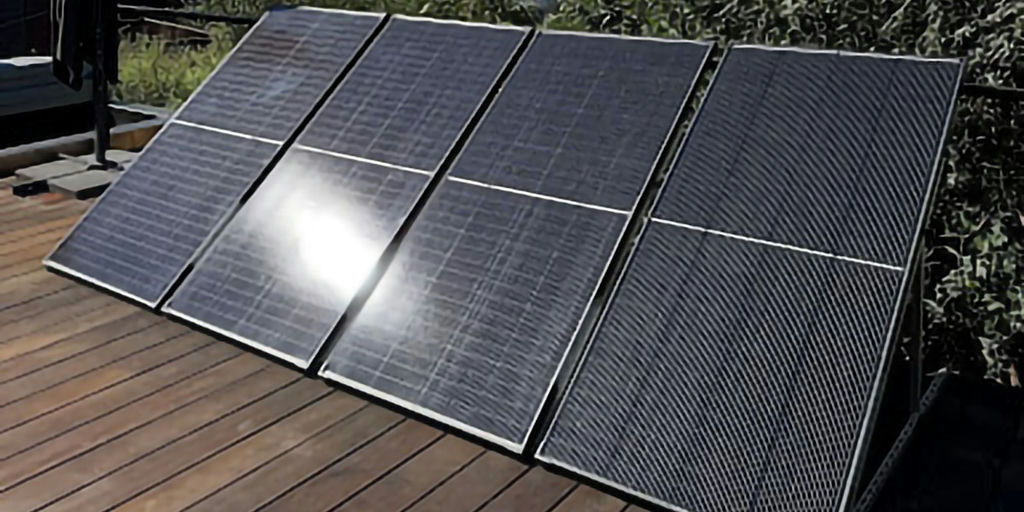
Photo courtesy of Bright Saver.
This is the fourth in a series of occasional articles on organizations fighting climate change. Earth Hero’s previous interviews are: Scientist Rebellion, As You Sow and Climate Justice Alliance.
Even as the amount of installed residential solar energy increases around the United States, only so many homes can fit a full photovoltaic system. That’s where balcony (or plug-in) solar comes in.
A single unit can be placed in an apartment on a balcony, railing, wall, or other location that is exposed to the sun. It can then be plugged into an outdoor outlet to provide a small amount of clean energy — generally 400 or 800 watts, enough to help juice appliances and lower a home’s energy bills as it pulls less electricity from the grid.
Plug-in solar has proved exceptionally popular in Europe, with over 1.5 million systems deployed across Germany alone, according to the organization Sun Hours. Yet remains a work in progress in the United States, where under 50,000 units are in place.
The nonprofit organization Bright Saver wants to change that. Through a membership program costing as little as $29 annually, participants get access to plug-in solar kits at market cost (currently $285.30). Bright Saver is also advocating for legislation in all states to promote deployment of the technology. These laws are needed to exempt plug-in solar from the interconnection regulations designed for significantly larger systems, barring them from (per Solar.com) sending electricity back into residential outlets, said Cora Stryker, co-founder of the California organization.
To date, 10 states have passed this legislation: Colorado, Connecticut, Maine, Maryland, New Hampshire, New Jersey, New York, Utah, Vermont, and Virginia. Legislation remains active in five other states.
“In Germany, you have this incredible thing where you can go to IKEA or even a grocery store, a local hardware store, buy balcony solar for a few hundred euros, bring it home, plug it in, and that's it. We will never get there unless we pass these laws that make it that easy,” Stryker told Earth Hero.
In the following interview, Stryker discusses Bright Saver’s background and mission, the case for plug-in solar, and the outlook for these systems as more states pass interconnection legislation.
The interview has been edited for clarity and length.
Tell us about Bright Saver's background and its mission.
Bright Saver’s a nonprofit. We started Jan. 5, 2025. It's been this meteoric ride. We started with this vision of, hey, solar is the cheapest energy on the planet. Let's make it accessible to everybody.
We're climate change people and tech founders, and we always saw balcony solar as the tip of the spear into wider clean energy awareness — a lot of people don't know it's cheaper than the alternatives — and growing from there into a broader clean energy movement, both on a consumer and a policy level. So that's our vision: We want everyone to have access to solar energy, particularly renters and folks who don't own their roofs.
Talk about the nuts and bolts of your work, your operations and what you would say are the central accomplishments in the organization’s early existence.
I'll answer that by talking a little bit about the story, where we started, where we are now. We started with this idea of starting small, like a hundred households. We're based in the Bay Area, so we imagined Cal students and folks in trailer parks. We imagined this small, 100-household proof of concept, showing that people save money, showing that there's an interest, and we imagined it growing slowly from there.
The fascinating thing is that, to our surprise, a couple months into that proof of concept, we got an email from PG&E [Pacific Gas and Electric Company]. It was not a legal threat, but it very firmly said, hey, even though these balcony solar systems you're installing have no interactivity with the grid, never feed electricity back, you still need an interconnection agreement. And it was one of these light-bulb slash roadblock moments. I think I went home and cried a little bit. I was like, oh my god, what are we doing, how are we gonna do this? And then, simultaneously, we saw that our hero [state Rep.] Ray Ward in Utah passed interconnection reform for balcony solar unanimously through Republican-led chambers.
Those two things happened at the same time. And that's where we thought to ourselves, ah, we need to repeat what happened in Utah. We thought a year ago, maybe we'll get two, three states to introduce legislation doing what Utah did. In the end, it was 35 states plus D.C. that introduced legislation. But that has been just, honestly, the greatest thing that could have happened for this movement, because it gave us a movement to build, and it built very quickly, millions of people getting excited about this, for a number of reasons
Many of us in the climate movement, it seems so dismal, we're so depressed. We fought so hard for the [Inflation Reduction Act] and then the administration changes. Suddenly we no longer have the biggest investment in clean energy around the globe. So, what do we do? We think this balcony solar movement has captured the attention of a really frustrated group of people who care about climate. We've been crying Chicken Little, we've been waving our hands, and we don't understand why so many Americans aren't joining us and taking climate action. Balcony solar is the way in, because it expands the climate movement beyond longtime environmentalists to people who frankly don't care about climate or think they don't care about climate because they think they can't afford it. So that has been our central mission from the beginning: lower people's energy bills and greenhouse gas emissions, and build this huge movement, sort of the AARP of clean energy meets the Costco of clean energy.
What new or different laws are required to advance plug-in solar? And how is Bright Saver trying to help with that mission?
We're a nonprofit, so primarily we're educators. We educate policymakers, fellow advocates, on the technology, on the policy trade-offs. I don't think it's too much to say we're leading the movement. We're the people who put this on the map, and we are the ones driving it forward in collaboration with a huge number of climate groups.
That's our role in changing the policy, which is the first necessary step. It's that interconnection reform. It says for these little systems, you don't need to go through the same process you would for rooftop solar for systems five to 20 times as large. It means submitting technical diagrams, applying for an interconnection. Sometimes it takes months.
In Germany, you have this incredible thing where you can go to IKEA or even a grocery store, a local hardware store, buy balcony solar for a few hundred euros, bring it home, plug it in, and that's it. We will never get there unless we pass these laws that make it that easy.
What makes balcony solar particularly advantageous for consumers and as a resource against climate change?
A couple things. Number one, if you get rooftop solar in this country, about half of the cost is what we call soft costs: cost of installation, cost of permitting, cost of this technical inspection. And we find that to be an atrocity — and we love rooftop solar. We think this interconnection reform should be the beginning of wider interconnection reform in the solar industry writ large in this country.
Here's why balcony solar is so revolutionary—the cost to you and me, the cost to consumers, is lowered to the actual cost of the technology, which is about half what it is in this country for rooftop. Because you're installing it yourself so you're just paying for the technology. That's what Bright Saver is doing. We are, as a nonprofit, selling this technology. I don't even like the word sell; we're offering it at exactly what it costs us. Why does it cost less to us?
Because we do bulk purchases, we negotiate much lower prices for our members. We've already started building this movement, but this is the next step to really codifying this movement into a consumer block that shapes clean energy markets, starting with balcony solar, but not ending. And at the same time shapes and drives the clean energy policy that is going to make these clean energy technologies affordable to everyone and accessible to everyone.
How many of the units has Bright Saver sold?
Today's Monday. We started last Monday. We're at about 100 to 200 today, with no advertising, with no paid anything. It's just word of mouth. [At the time of writing, membership had grown to 1,000.]
Bright Saver's vision is that we build this huge membership in the millions, as formidable.as AARP, and we sell the cheapest clean energy options there are, like Costco, and simultaneously build the movement beyond those of us who have been waving our hands, screaming Chicken Little, of which I've been one.
What will it take to meet your vision for the future?
Let me say something else about the membership. We thought people would join because they want the cheapest balcony solar unit. Guess what? It's about three to one. More than half the people who join the membership don't buy the thing. We are kind of scratching our heads trying to figure it out. And honestly, I think it's because people believe in this vision, this self-sustaining vision, this market-driven solution to climate change that advocates like us just have to push over the edge.
The economics are in our favor, the technology is in our favor, but we have to fight the powers that be that want to slow down the clean energy transition. That's really what Bright Saver's doing, and that's really what this huge membership we are working on building does. We need tens of thousands, hundreds of thousands, millions to really stand up and say, hey, we need this both to reduce our energy prices and also to save ourselves from climate change.
How does the United States compare in uptake of these units to countries like Germany?
We're super behind. Germany's been at this for 10 years; it started as kind of a DIY guerrilla solar movement. It started without legalization, sort of similar to how the rooftop solar movement in this country started. Because it started that way, it took 10 years to get to where we are now, which is 4 million of these units in Germany. One in 10, almost, Germans has these. But it took 10 years, and we don't have 10 years when it comes to climate or energy affordability.
We're trying to speed this up. If this year has been any indication, it's that we feel more hopeful than ever that we will move much faster than Germany, even without subsidies, even without policy that supports this, because it is simply the cheapest option for energy in general.
What do you think will be the pace of legalization and the pace of deployment of plug-in solar?
We wrote a white paper, we released it in November of last year, and we saw ourselves following the German adoption curve. If you follow that, you're looking at about 60 million Americans having these by the end of the decade. We actually think that's going to happen faster. The reason we think that's going to happen faster is because we already have 10, maybe 11, states where this legislation has passed. More than 30 are already coming to us saying, hey, we want to do this again next year or we want to do this for the first time. So, we think the demand is so clear that it's not going to take that long.
Now, there are other headwinds we face in this movement that we didn't expect. But we believe that with this combination of pressure on policymakers to pass the clean energy policies that benefit us and shaping consumer markets by standing together as a negotiating block, we think that's the way to make it happen much more quickly than it would otherwise. You know, we have been rather astonished at the speed of this movement. And when we take stock of the last year, we actually think the most meaning we have made, the biggest dent we've made, is not in the gigawatts of balcony solar that are already and will be added to our production, it's actually in this coalition of strange bedfellows — Republicans, Democrats — uniting across the ideological spectrum behind this no-brainer idea that the cheapest energy to produce should be the cheapest to you and me.
You don’t know what you don’t know, but we’re looking at that target, 60 million Americans, even faster than 2030.
The best indicator of whether you're going to get rooftop solar is do your neighbors have it? So, we see this really profound contagion that happens where you live in a neighborhood where no one has rooftop solar. Your neighbor gets one of these balcony solar units. You start talking to them. They talk about how their energy bills are going down, while yours are still going up. That is the tipping point. That's how people who think they can't afford, literally, to care about climate, adopt clean energy en masse. But someone has to be the organizing force.
What have been those headwinds, both anticipated and unanticipated?
Maybe naively, when we first started this, we thought, hey, utilities maybe will be psyched about this. There's no net metering agreement. You're completely exempted. You're giving them free electricity — a little bit, not a lot — we're taking load off the grid, they're delaying costly infrastructure updates. Turns out, surprise, surprise, that's not true. In some places it is – In New York, the biggest utility, Con Edison, did support this legislation, but generally they didn't.
We knew that was a possibility. There are other entities that just don't want to see this happen because they're not thinking about the benefit to you and me. They're thinking about the benefit to their bottom line.
So, we've got some barriers to knock down. We've got renter's rights. Germany did this in two legislative waves. The first one is what we're seeing this year, it's interconnection reform. But a couple of years later, they did renter's rights, saying you can't prevent your renter from installing these, except under very particular circumstances like it's a historical building. If you talked to me a year ago, I would have thought it would be impossible for any U.S. state to do that in one fell swoop. Guess what? Colorado did it, Virginia did it, New Jersey just did it last week. I think the most forward-thinking states have the power to make this go even faster.
When it comes to the solar kit itself, what should consumers be thinking about when it comes to cost, installation, or other issues?
Retail, the cheapest one costs around $499, $500. Because we're a nonprofit, we're offering it at $285.30, that's exactly what it costs us to buy it in bulk. We do it at a loss, because we have folks working very hard to make this happen, and we have to pay them so they can feed their families. Plus, a $29 a year membership. That's important, because if we don't build the membership that lasts beyond this year then we have a shorter runway of transforming the clean energy market and availability in this country.
It's very simple to set up. If you order one of these, it'll be shipped to your doorstep. You just open the box, you take it out, you connect the inverter to the solar panel, and you plug it in. That's all it is.
Big picture, what can individuals be doing other than buying a unit to advance this vision?
The most meaningful thing you can do actually is become a member of Bright Saver. As I mentioned earlier, less than half of the people who become members in the week we've been doing this, actually buy the kit. That makes us really hopeful because what it tells us is that it's not transactional necessarily, or rather it is for 30% to 40% of people, But that's who we want to reach – we want to reach the people who don't care. The most meaningful thing you can do is support the movement, support the big vision, become part of this collective negotiating block that will shape policy and consumer markets because this goes way beyond balcony solar. We are going to do this with clean energy technology after technology.