Historical Art Movements and Environmentalism
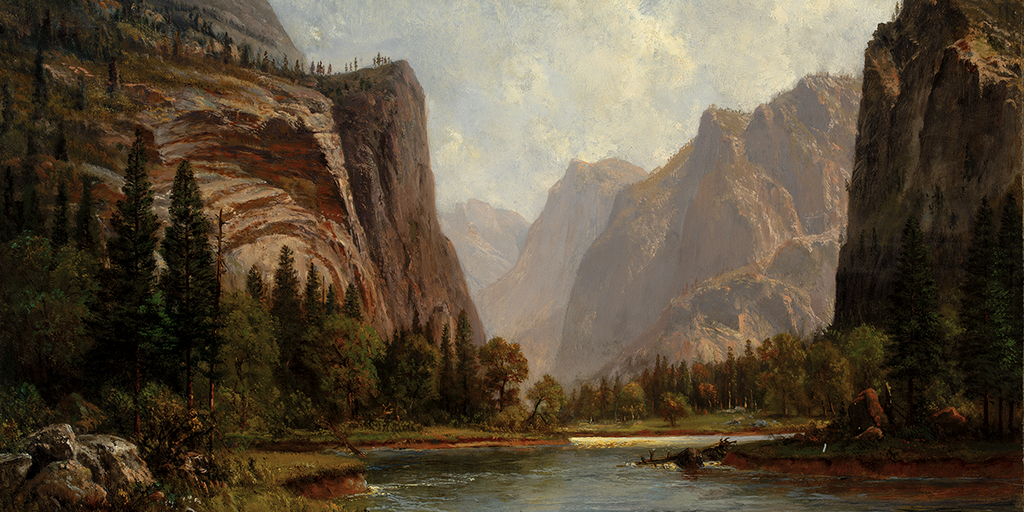
Albert Bierstadt, Gates of the Yosemite, Bequest of Marvin J. and Shirley F. Sonosky in memory of Harryette Cohn
Art, through its nonverbal mediums, has the power to captivate a viewer and inspire revolutions. Artistic movements have emerged as a reaction to societal change, with the art itself being a manifestation of reflection and perception. Historically, art has not only responded to humanity’s growing distance from nature but also helped lay the philosophical foundation for the environmental and climate activism that continues today.
Pop Art incorporated imagery from popular culture and advertising, often replicating or drawing inspiration from mass manufacturing processes. While Pop Art responded to the rise of consumer culture, other artistic movements reflected broader consequences of modernity: humanity’s departure from the natural world.
For hundreds of years, we have sown the seeds of industrial plants, which have blossomed into mechanized, urban landscapes. When industrialism began in the late 1700s, so did Romanticism. The Romantics believed that emotional power and natural intuition, not just reason and order, were equally valid ways to understand the world. Artists at this time focused on the beauty, awe, and the sublime in their work. Romantic art rejects industrial change, emphasizing an individual’s connection to nature and a longing for the old ways of life.
In Caspar David Friedrich’s 1818 painting, The Wanderer Above the Mists, a lone man stands at the edge of a rocky cliff. He faces towards the foggy landscape below him, framed by vast and towering mountains. The work reflects a core belief of Romanticism: nature is not something to be conquered, but something to be confronted with humility and awe.
This perspective of the natural world inspired artists to capture the iconic American landscape, such as Albert Bierstadt in Gates of the Yosemite and Thomas Moran in The Grand Canyon of the Yellowstone. Their paintings show nature in its rawest form, bigger than life, overfilled with emotion. The way they portrayed landscapes created worthiness for protection from industrial, mechanized use.
Along with inspiring other environmental artists, Romantic thought created a domino effect of romantic ideals. It fostered a philosophical world in which pioneering thinkers like Aldo Leopold, author of A Sand County Almanac, could later thrive. He developed the Land Ethic, a moral code that tied romantic ideals to emerging environmentalism. The Land Ethic presents the idea of the natural world as a community, one in which humans are deeply intertwined. This concept is one of emotion, declaring a respectful connection over domination in the natural world.
By reframing the natural world as sublime rather than rational, the movement reshaped how Americans understood the natural world. It invited dialogue about preservation and conservation, and eventually shaped national policy. After The Grand Canyon of the Yellowstone reached the desks of the federal government, “capturing the imagination of Congress,” President Ulysses S. Grant established the first national park, Yellowstone National Park.
The remains of Romanticism are sprinkled throughout modern environmentalism. The Romantic philosophical values of reverence and emotion for the natural world over an industrial one are very much prevalent today. Romantic artists transformed landscapes into symbols of ethical responsibility, inspiring protective institutions and pioneering environmental thinkers like Aldo Leopold. Even though the movement began hundreds of years ago, it left a living influence on environmental change. Today, environmental activism still draws on this legacy of using art and imagery to spark care, reflection, and action.